
Black Waters, Broken Promises: Can we save the rivers of Dhaka?

Own report
Published: 04 March 2026, 09:36 am
The Mississippi is a representation of liberty, a course, a moral compass, a sensitive boundary in the entries of ‘Huckleberry Finn’, a popular novel by American author Mark Twain. In the British Nobel prize winning poet T. S. Eliot in his work ‘The Waste Land’, the Thames represents as a polluted river, with the currents of the river contaminated and civilization in spiritual decline. And in Bengali verse, as in the evening moments of Jibanananda Das, in the furious roll of the thunder of the songs of Kazi Nazrul Islam.
The history of the city is hardly any different than that of the Thames in T. S. Eliot lament, The River Sweats Oil and Tar. The Thames was declared in the middle of the 20th century that it is dead in London. But, due to some eco-friendly programs, the Thames River still flows as a symbol of the beauty of the city of London.
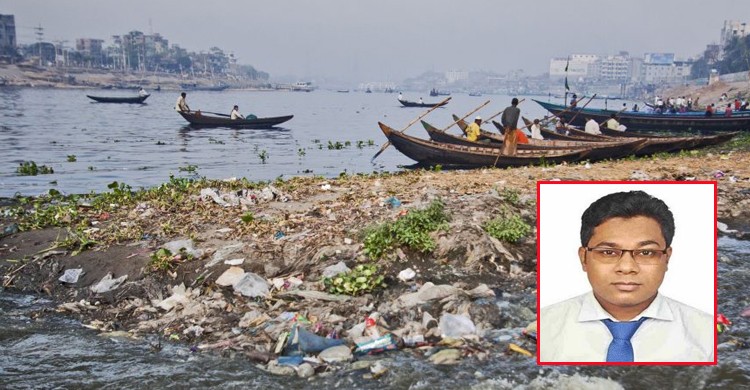
Dhaka city was constructed along the river system of life-giving and life-saving rivers long before it became one of the most populated megacities in the world. The Buriganga, Turag, Balu, Shitalakhya, Dhaleswari and Tongi Khal were not just the geographical aspect; it was the core of the economy of the capital, culture and character. These rivers were used to ferry trade vessels, provided sustenance to fishing villages, irrigate lands and dictate the cycles of city life. They have maintained lifestyles and determined the role of Dhaka in the history of Bengal. That legacy is at an unsafe heritage today. During dry seasons, huge portions of such rivers become black. The waste fats up the water. The level of dissolved oxygen becomes low enough to suffocate water-borne life.
The odour of some of the banks of the Buriganga or Turag, may be nauseating. What used to be picturesque waterways have been made out to be stagnant drains. This change should not occur in one day. It is the consequence of dozens of years of intensive growth, industrial development, poor regulation and unsanitary sewage system. However, in recent scientific works, there is an indication that the situation is not fatal, but it can be reversed.
Over the past few years, a number of scholars both local and international have conducted research to provide one of the most detailed evaluations to date of the deteriorating river crisis in Dhaka and the responses put forward by the government on how to address it. Modelling of conditions in rivers over a length of over 250 kilometres and established interconnected river channels have enabled the researchers to give a better understanding of how large-scale degradation is occurring, what pressure is contributing to it, and how planned development and sanitation projects are likely to affect it. Instead of isolated measurements, this wider research project integrates field measurements, hydrological modeling and predictions to gain a deeper insight into how Dhaka rivers can react to expanding infrastructure, population increase, and environmental transformation.
Dhaka is not only a capital city, but it is an economic center of Bangladesh. It contributes to about 40 percent of the GDP in the country. It has its textile and garment industries that are the main export in the country. The steel, leather, finishing and dyeing plants are also growing tremendously in the past few decades. Such expansion has lifted millions of people out of poverty and made Bangladesh a major force in the world production. Economic transformation has however not been accompanied by environmental protection. Various research determines a number of key factors that have contributed to the degradation of rivers in Dhaka. To begin with, the coverage of sewage has been very low in the past. The City used to be served by only one big sewage treatment plant, Pagla that was operating until April 2022, and that was only capable of treating a tiny percentage of the daily wastewater generated. There were still millions of residents who were not connected to any sewerage system. This led to the uncontrolled domestic waste being discharged into the local rivers and canals. Second, the industrial discharges have been an enormous burden. Thousands of factories, in particular washing, dyeing and finishing textile plants release wastewater that contains a lot of organic matter, nutrients, heavy metals and chemical residues. There have not always been consistent compliance and monitoring even where some of the facilities have effluent treatment plants. The river system has found its way to untreated waste or a partially treated waste. Third, the situation is aggravated by seasonal flow change. The upstream flows decline in intensity during the dry season, which is between November and March. The rivers become incapable of diluting pollutants. There is a spike in contaminant concentrations and a collapse in dissolved oxygen. The ecological stress is the most noticeable in these months. Fourth, infrastructure development has been lagged behind by unplanned urban development. The illegal connections and poorly maintained pipelines lead to massive misconnection in informal settlements. Not all the wastewater is treated even in an area where a treatment facility is located. A research surveys between 2017 and 2021 had very high levels of ammonium, nitrate and phosphorus in a number of river reaches. The amount of dissolved oxygen in certain locations went to zero during dry season. Ecologically, such conditions make rivers dead.
Researchers applied a dynamic process-based system, the INCA model, to get out of isolated sampling and ambiguous observation. This coupled catchment model is used to model the hydrology and nutrient transport based on varying land use, climatic, population growth and wastewater discharge conditions. Having been tested as valid, it was applied to test three scenarios. The former case was a reflection of the state of affairs in the area by 2020, including current sewage treatment capacity, the current climate and population rates. The second case forecasted the short-term trends at about 2027 such as new sewage treatment plants in construction with a relatively constant population and climate. The third situation went as far as 2050. It took the entirety of Dhaka Sewerage Master Plan implementation, included the estimated population growth of 16 percent, and used the effect of climate change. Such infrastructure projects cost billions of takas to build. The insufficient capacity needs or connection rate estimation without evidence-based planning might make the city spend decades in poor performance.
The Dhaka Sewerage Master Plan foresees that in the following twenty years, over a dozen large sewage treatment facilities would be built and enlarged. Besides upgrading the Pagla plant, it has plans or is constructing new plants in such areas as Uttara, Mirpur, Rayerbazar, Narayanganj, Savar and Keraniganj. The Dhaka Water Supply and Sewerage Authority (DWASA) is spearheading implementation with international financing institutions like the World Bank coming in to its support.
Climate scenarios were also studied in view of the put-up global modelling frameworks. It has been projected that there is likely to be greater monsoon flows and extreme events that may be more severe. Alteration of low flow conditions is not certain. Interestingly, the researchers have discovered that, though climate change is a relevant factor, it is not the leading cause of water quality extremes in the rivers of Dhaka. The volumes of discharges of the pollutants are still the most important factor. Dry-season oxygen collapse still occurs in situations of excessive effluent loads even when there is an increase in monsoon flows. This finding is significant. It stresses the idea that the local control over authority and pollution are much more conclusive than global climatic tendencies in defining the further fate of the rivers. The Importance of Dissolved Oxygen. The main goal of river health is dissolved oxygen. With a level of less than two milligrams per litre, majority of fish species will find it difficult to survive. Close to zero levels permit an anaerobic activity that causes gases like hydrogen sulphide and methane that cause foul odours and unhealthy environments. The effects do not just affect aquatic environments. The situation is aggravated because the sewage is untreated and the water that is utilized by the surrounding populations is contaminated. Fishers also lose their incomes due to decreased stock. The transport by the river becomes less feasible. The aesthetic loss of waterways lowers the property values and detracts any investment. Shallow groundwater may also be affected by polluted surface water by means of hydrological interaction. Bangladesh has made efforts to attain the Sustainable Development Goals such as clean water and sanitation. The most important way of fulfilling these commitments is to revive the rivers in Dhaka.
Connection rates are one of the most 1 revealing issues of the modelling exercise. Not all households and industries are connected to sewage treatment plants even in places where they are located. Squatter settlements, unauthorized discharging points as well as ruptured pipelines lower overall performance. When the wastewater is only treated at 65 percent of the wastewater, the 35 percent still flow into the rivers and contaminate them. Such a percentage in a city of more than twenty million citizens is a huge amount of waste. Moreover, the performance of the plants should be in accordance with the design. When the maintenance is insufficient, when energy disruption interferes with the functioning or when the sludge disposal systems are passed out, the efficiency of the treatment becomes compromised.
The problem of municipal wastewater is not the entire equation. The garment and textile industry, which is the main export sector in Bangladesh, produces high organic mass level of wastewater and chemical residual wastewater. The Tanneries that were historically concentrated in the Buriganga area before they were relocated have left behind traces of heavy metal pollution. The modelling implies that expanded municipal treatment will not be able to meet the requirements without enforcing the implementation of industrial pre-treatment and discharge standards. Strategies that can be adopted to ensure that this is effectively implemented are to ensure strict monitoring of the outfalls, have their compliance reported transparently, provide economic incentives to produce cleaner and have zero tolerance of direct discharge into waterways.
This is not the only predicament facing Dhaka. The river Thames in London was declared dead in the middle of the 20th century. It was later restored by decades of investment in wastewater regulation and treatment. Cheonggyecheon stream in Seoul is a route that used to be a polluted stream underneath a highway, but was converted into a renewed urban route. There are elements of successful river revival: basin wide planning, constant monitoring, adaptive management, political commitment and long-term funding. Dhaka has now acquired science in terms of sophisticated modelling. This is a problem of implementation.
City rivers are usually handled as waste gates. Nonetheless, healthy rivers offer good ecosystems. They control floods, tame urban heat, sustain fisheries, provide recreational areas and maintain cultural heritage. The economic value of restoration of rivers in the long term is most likely greater than the treatment infrastructure costs. The health care costs are minimized by cleaner rivers, the real estate value and investor confidence are better.
The research comes to the conclusion that the suggested sewage treatment facilities are effective but not enough when population growth is not regulated and industrial pollution is not eliminated. A number of priority policies can be identified. To start with, the physical infrastructure should be extended with vigorous attempts to link households and industries to the sewerage. Second, expansion facilities should be developed in such a way that the treatment plants can expand in the future. Third, the industrial pre-treatment standards should be stringently enforced. Fourth, the number of real-time water quality monitoring networks must be increased in order to monitor the distribution and flow of dissolved oxygen and nutrients. Fifth, options on how to sustain or increase dry-season flows need to be considered. Lastly, it is important to engage the community. Accountability and popular support can be developed through river stewardship programs.
The future of the Buriganga and Turag is not just a problem of the environment. It is indicative of the enhanced ability of urban Bangladesh in planning, regulation and wise investment to future generations. Dhaka might become the example of rapidly urbanising cities in South Asia in the event the Sewerage Master Plan becomes successful. Failure will have a long-term effect that will last decades. The stakes have been made clear through science. The modelling indicates that recovery can be achieved, but only with long commitment, good enforcement and dynamic management. Now is the question as to whether Dhaka will reestablish its rivers. The solution will determine the environmental legacy of the city to the future generations.
Zahidul Islam
Research Scholars, Department of Geography and Environment
Jagannath University, Dhaka, Bangladesh
Teacher, Bangladesh Studies and Geography
Manarat Dhaka International School and College, Dhaka, Bangladesh
E-mail: zahidulislam1326@gmail.com
Read More

Civil–Military Harmony Essential for Strong State Building: Defence Adviser at DC Conference
Seven Arrested, Including Mastermind, Over Extortion Attempt at CKD Hospital

New Era in Malaysia’s Labor Market: AI to Curb Syndicates in Worker Recruitment